

Don’t scrimp on AV! Why technology must be the cornerstone of your office refurbishment
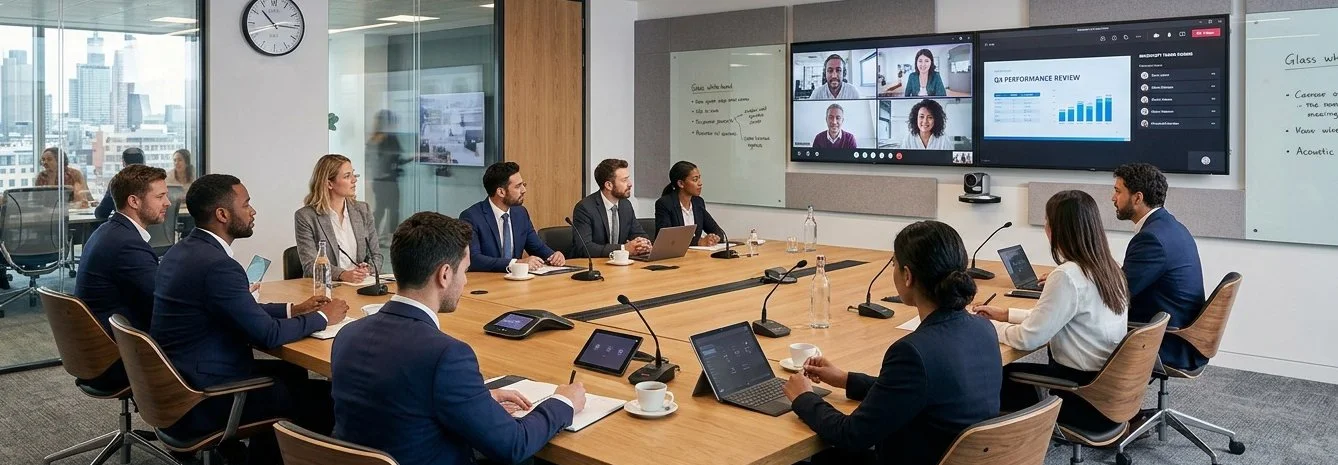
“It’s absolutely crucial that an appropriate budget consideration for AV is planned right at the very start of any refurbishment process. This means understanding exactly who the end-users will be, what their requirements are, and what technology will be needed to ensure that meetings run smoothly with no complications or downtime.
“We’ve seen it time and time again over the years - companies that don’t plan AV solutions early on are left with big regrets at the end of the process; they build a shiny new boardroom that looks great, but sadly it just doesn’t function properly as the users need it to. The only remaining choice then is to either deploy an expensive retrofit, or to make-do with sub-standard AV equipment as an afterthought.
“Our advice is clear - make sure that AV integration specialists are invited at the very start of your project blueprint, so you can develop and cost-up a proper specification that caters for all your AV needs.”
Russell Miller, AV2000 Ltd.
Audio visual technology is frequently treated as a late-stage add-on during corporate office fit-outs, behind furniture and cosmetic design. However, optimising AV infrastructure first prevents costly structural retrofits, eliminates acoustic failures, and ensures hybrid meeting equity. Modern workspace design requires placing AV at Stage 1 of the procurement sequence.
When a business decides to fit out a new workspace or undertake a major office refurbishment, the budget discussions usually follow a predictable path. Managing Directors and project leads spend weeks agonising over swatches of plush carpet tiles, sleek Venetian blinds, hand-picked ergonomic chairs, and bespoke solid-oak boardroom tables.
The goal, understandably, is to create an environment that looks stunning, reflects the company brand, and impresses clients the moment they walk through the door.
Yet, far too often, Audio-Visual (AV) technology is treated as an afterthought - a line item crammed into the tail end of the budget or left until the plaster is dry and the paint has set.
This approach is fundamentally back to front. In the modern working world, your AV infrastructure is not a luxury accessory; it is the central operational core of your entire workspace.
What is AV-First workspace design?
AV-First Workspace Design is an architectural and interior procurement strategy that prioritises technology infrastructure (cabling, acoustics, displays, and microphony) prior to selecting spatial layouts, wall treatments, and furniture. Designing around digital communication channels first ensures physical environments support hybrid collaboration without expensive structural modifications post-completion.
The Core Pitfalls of Late-Stage AV Integration
When AV hardware and software integration is relegated to a late-stage decision, corporate refurbishment projects incur predictable operational and financial penalties:
Destructive Retrofitting: Attempting to re-route cabling, mount interactive flat panels (IFPs), or position ceiling mic arrays after drywalling and ceiling installation requires invasive trunking, exposed wires, or remedial builder works.
Acoustic Disasters: Highly reflective surfaces - such as glass partitions, hard flooring, and solid boardroom tables - exacerbate reverberation time. Without early acoustic dampening and integrated microphony, remote participants experience excessive echo and unintelligible audio.
The "Dongle Nightmare": Unintegrated hardware relies on ad-hoc adapters, loose cabling, and manual input switching. Meetings routinely lose 10 to 15 minutes to troubleshooting, directly degrading executive productivity and client trust.
Key takeaway: A new £10,000 boardroom table cannot salvage a high-stakes pitch if remote stakeholders cannot hear the presentation due to poor acoustic planning.


3 reasons why AV consideration must come first
Designing around your technology infrastructure from day one ensures that every square metre of your new office functions as intended.
1. Your meeting spaces must cater for all participants, both physical and virtual
Modern enterprise operations rely on hybrid collaboration platforms such as Microsoft Teams Rooms (MTR) and Zoom Rooms. Whether pitching to international investors or conducting cross-departmental catch-ups, remote participants require equal visibility and audio clarity. Designing spatial layouts around screen positions, pan-tilt-zoom (PTZ) camera angles, and beamforming microphone arrays guarantees that every participant - physical or virtual - maintains equal presence.
2. Technical requirements are more important than office aesthetics
Selecting furniture prior to mapping out AV workflows creates structural conflicts:
Boardroom tables may lack integrated cable management or floor box alignment.
High-backed chairs can obstruct camera sightlines.
Unplanned pendant lighting can introduce direct glare onto high-brightness commercial displays.
Involving AV integration specialists alongside architects during early spatial design ensures power drops, floor boxes, and acoustic paneling are built around technological requirements.
3. It’s smart to future-proof your capital expenditure (CapEx)
Corporate office refurbishments typically operate on 5 to 10-year lifecycles. Specifying scalable, software-defined AV infrastructure during early procurement enables seamless firmware updates and hardware expansion, protecting your initial CapEx without needing full system tear-outs as platforms evolve.
Recommended office refurbishment procurement sequence
To eliminate the friction of late AV adoption, capital projects should adhere to a structured four-stage procurement model:
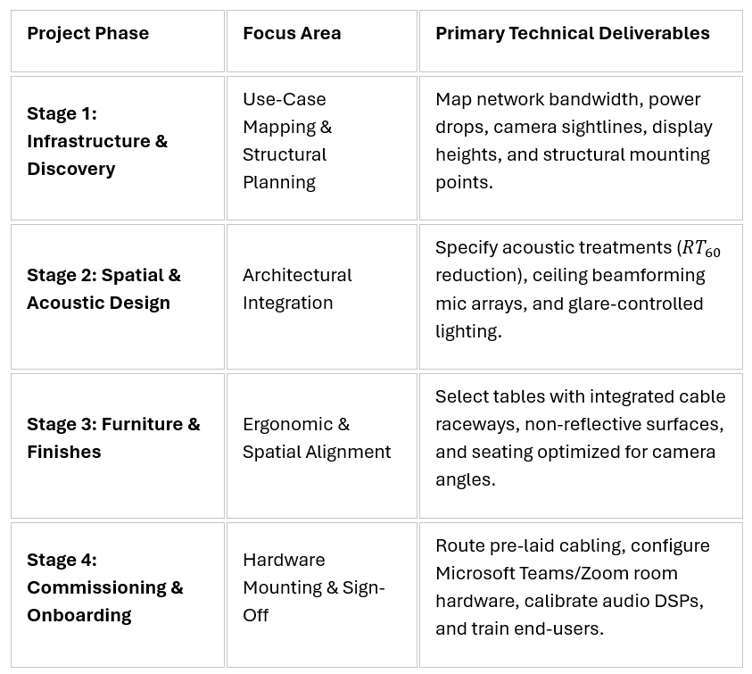
Summary: Before committing your capital budget to interior finishes, bring your interior designers, architects, and AV integration specialists together at Stage 1. Placing audio visual design at the centre of your project blueprint ensures that every square metre of your workspace delivers maximum return on investment.
Frequently Asked Questions
What does "AV" stand for in an office context?
AV stands for Audio-Visual. In a corporate workspace, AV encompasses all the sound, video, display, and digital collaboration technologies used across meeting rooms, boardrooms, huddle spaces, and open-plan areas - including displays, cameras, microphones, speakers, and control interfaces.
What is the difference between AV and IT?
While both fall under technology, IT (Information Technology) focuses on digital network infrastructure, data storage, cybersecurity, and software applications. AV (Audio-Visual) focuses on the physical hardware and environmental systems used to capture, transmit, and present media (such as screens, microphones, cameras, and room acoustics). Modern meeting spaces sit at the intersection where AV hardware runs on the IT network.
How much of an office fit-out budget should be allocated to AV?
Industry standards typically recommend allocating 8% to 12% of the total office refurbishment budget to AV technology, infrastructure, and acoustics. For tech-dependent or heavily hybrid organisations, this figure can reach 15%.
Why is AV technology often overlooked during office refurbishments?
AV technology is frequently overlooked because project management budgets traditionally prioritise visible cosmetic elements - such as furniture, flooring, and decorative lighting - over internal infrastructure. Furthermore, AV is often mistakenly categorised as a late-stage IT purchasing decision rather than a structural architectural requirement.
How does early AV integration save money on office fit-outs?
Early AV integration eliminates core cost drivers including post-construction drywall cutting, surface-mounted cable trunking, urgent electrical alterations, and custom furniture modifications. Planning cabling pathways and acoustic needs before walls and ceilings are closed dramatically reduces labour and remediation expenses.
What is acoustic reverberation, and why does it affect video calls?
Acoustic Reverberation measures the time required for sound pressure levels to decrease after a sound source stops. In rooms with hard surfaces (glass walls, concrete, polished wood), long reverberation times cause sound waves to bounce continuously, making speech muddy and incomprehensible for remote call participants.
Can we use existing consumer TVs and soundbars for meeting rooms?
Consumer-grade screens and soundbars are built for lower daily usage, lack centralised remote management, offer poor anti-glare capabilities, and generally omit the security protocols required by corporate IT networks. Commercial-grade AV displays and hardware are designed for continuous operation, integrate natively with platforms like Microsoft Teams or Zoom, and carry business warranties.
Investing in first impressions and operational performance
Your office furniture tells clients that you value aesthetics. Your AV technology demonstrates that you operate efficiently, embrace modern collaboration, and execute without friction.