


Published: October 2026
Topic: Charity Technology & Operations
Target Audience: UK Non-Profit Leaders, Trustees, & Chief Technology Officers
Executive Summary: Modern audio-visual (AV) technology is a core strategic asset for non-profit organisations across the United Kingdom. High-quality audio-visual systems improve donor retention, boost event fundraising yield, enable compliant hybrid governance, and deliver measurable return on investment (ROI) for third-sector organisations.
What is Charity Audio-Visual (AV) Technology?
In the UK non-profit sector, charity audio-visual (AV) technology refers to the integrated hardware, software, and acoustic systems used by registered charities to deliver fundraising events, virtual outreach, hybrid internal collaboration, and public advocacy. Core components include high-definition LED displays, assistive hearing loops (hearing impairment compliance), digital signage, webcasting equipment, and unified communication (UC) platforms.
4 Strategic Reasons UK Charities Require Professional AV Systems
1. High-Impact Storytelling & Donor Conversion
At the heart of every successful fundraising campaign is emotional connection. Traditional text-based appeals or low-quality presentations struggle to convey the full impact of non-profit field work.
Visual Immersion: High-definition LED screens and interactive displays bring beneficiary stories to life with clear, full-colour field footage.
Acoustic Precision: Crystal-clear sound reinforcement ensures emotional testimonials, beneficiary voices, and fundraising calls are heard without audio distortion.
Conversion Impact: High-impact audio-visual delivery turns passive audience listening into active financial support during fundraising appeals.
2. Maximising Revenue at Fundraising Events
Galas, charity auctions, and annual general meetings (AGMs) are critical revenue drivers for UK non-profits. Technical glitches directly impair fundraising yield.
Paging and Audio Clarity: Guarantees every pledge call, guest speech, and auction bid is clearly heard across large venues.
Real-Time Data Integration: Displays live leaderboards, sponsor recognition, digital donation tallies, and instantly updated VAT-compliant invoices.
Hybrid Webcasting: Expands audience reach by allowing remote supporters across the UK or abroad to participate via secure virtual platforms.
3. Cost Reduction via Hybrid Operations & Governance
Adopting enterprise-grade video conferencing technology delivers quantifiable administrative savings for UK charities:
Lower Travel Expenses: Regional teams, trustees, and volunteers meet virtually, cutting travel reimbursements and room hire costs.
Improved Inclusivity: Hybrid outreach allows volunteers and beneficiaries with mobility, geographic, or scheduling constraints to attend workshops and support groups.
Volunteer Onboarding: Recorded interactive training modules scale volunteer onboarding without incurring recurring staff costs.
4. Measurable Return on Investment (ROI)
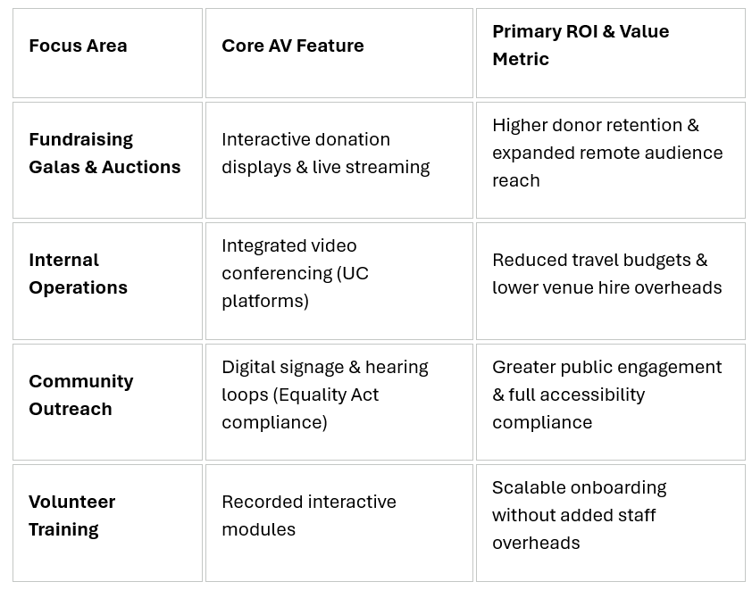
Finance directors and board trustees require a clear business case for capital expenditure. The table below outlines the core ROI metrics for non-profit AV investments:
Key Takeaway
Audio visual technology is no longer an optional luxury for non-profits - it is a force multiplier for fundraising, a foundation for hybrid governance, and a vital bridge for community engagement. By prioritising robust AV infrastructure, UK charities ensure their mission is clearly communicated, widely heard, and acted upon.
Frequently Asked Questions
1. Why is professional AV technology important for UK charities?
Professional audio-visual (AV) technology is a core strategic asset for UK charities because it directly increases fundraising yield, lowers operational travel costs, and ensures compliance with UK accessibility standards. High-definition LED displays and precise sound reinforcement elevate donor emotional engagement at galas and auctions, turning passive supporters into active financial contributors. Furthermore, integrated unified communications (UC) systems enable hybrid governance and remote trustee participation.
2. How does AV equipment improve fundraising yield at charity galas?
AV equipment increases fundraising yield by eliminating audio dropouts during pledge calls and displaying real-time digital donation tallies, interactive auction leaderboards, and live donor recognition. Clear acoustics ensure every speech, beneficiary testimonial, and auction bid is heard without distortion across large venues, while integrated webcasting systems allow remote supporters to participate and donate live from anywhere in the UK.
3. What AV accessibility standards must UK non-profits follow?
UK non-profits must adhere to the Equality Act 2010 by providing reasonable adjustments for individuals with disabilities. In terms of AV infrastructure, this requires installing assistive hearing loops (induction loops) or infrared listening systems in venues, incorporating live captioning or British Sign Language (BSL) interpretation during webcasts, and ensuring digital signage features high-contrast visuals for visually impaired attendees.
4. How can non-profits reduce administrative overheads using hybrid AV systems?
UK charities reduce administrative overheads by replacing unnecessary regional travel with enterprise-grade video conferencing and unified communications (UC) platforms. Installing permanent room systems (such as Zoom Rooms or Microsoft Teams Rooms) in offices allows trustees, staff, and volunteers to hold compliant hybrid board meetings, Annual General Meetings (AGMs), and volunteer training sessions without incurring venue hire fees, catering expenses, or mileage reimbursements.
5. What are the key AV hardware components required for charity events?
The core AV hardware components for charity events include:
Digital Visual Displays: High-brightness LED walls or laser projectors for showing beneficiary videos and donation tallies.
Acoustic & Paging Systems: Wireless cardioid microphones, digital mixers, and line-array speakers to eliminate feedback and ensure clear speech delivery.
Webcasting & Streaming Encoders: PTZ (pan-tilt-zoom) cameras and dedicated streaming hardware for hybrid event broadcasting.
Assistive Listening Equipment: Fixed or portable hearing loop systems to maintain accessibility compliance.
6. How do UK charities calculate the return on investment (ROI) of AV investments?
UK charities measure AV return on investment (ROI) across four key operational metrics:
Fundraising Growth: Percentage increase in total gifts collected during live and hybrid fundraising galas.
Operational Savings: Direct reduction in travel expense claims and external room hire fees through hybrid video conferencing.
Audience Reach: Growth in virtual attendees and remote donor participation during annual general meetings and public webinars.
Volunteer Onboarding Scale: Hours saved by staff using pre-recorded interactive visual training modules.
7. How can UK charities secure funding for AV infrastructure upgrades?
UK non-profits fund AV technology upgrades through capital grants from grant-making trusts, corporate partnership sponsorships, equipment leasing arrangements, and non-profit technology discount schemes like TechSoup UK and Charity Digital. Leasing allows charities to preserve vital cash reserves while spreading hardware costs into manageable operational expenditures.
8. What is the difference between consumer-grade and commercial-grade AV equipment for non-profits?
Commercial-grade AV equipment is designed for continuous 16/7 or 24/7 operation, higher brightness levels (measured in nits or lumens) suitable for brightly lit community halls, and integrated centralized management. Consumer-grade electronics (such as home televisions or domestic webcams) lack the necessary durability, warranty support, acoustic range, and security protocols required for official charity governance and large-scale public events.
9. Why is acoustic treatment important in charity venues and halls?
Acoustic treatment (such as wall panels and sound absorbers) is essential because many non-profit venues, heritage buildings, and community halls feature hard surfaces that generate heavy sound reverberation and echo. Without proper acoustic management, speech becomes unintelligible—causing audience fatigue, obscuring key fundraising appeals, and rendering hearing loops ineffective for hearing-impaired patrons.
10. How does video conferencing technology support charity trustee governance?
Dedicated video conferencing hardware ensures compliant, secure, and fully recorded governance reviews for charity trustees. High-definition PTZ cameras and ceiling microphone arrays ensure that remote trustees can clearly see presentation materials, vote securely on board resolutions, and review annual accounts without requiring all board members to physically gather in one location.