

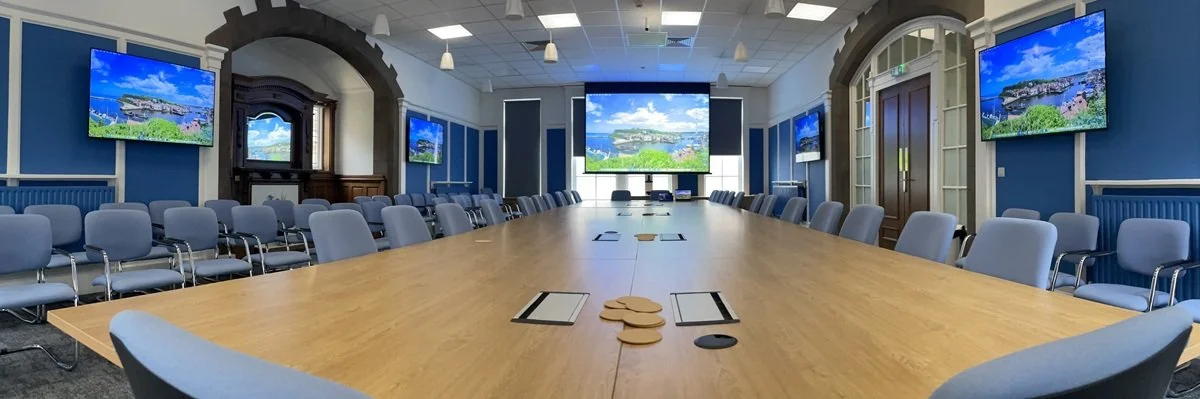

Natural speech and hybrid meetings across a large boardroom
Leeds Teaching Hospitals NHS Trust is one of the largest and busiest acute hospital trusts in the UK, operating seven hospitals across five sites to deliver local care, regional specialist services, and medical training.
Client: Leeds Teaching Hospitals NHS Trust
Location: St James’s University Hospital, Leeds
Scope: An integrated audio visual system to bring presentations, hybrid meetings and voice lift facilities together in one large boardroom.
Project Brief
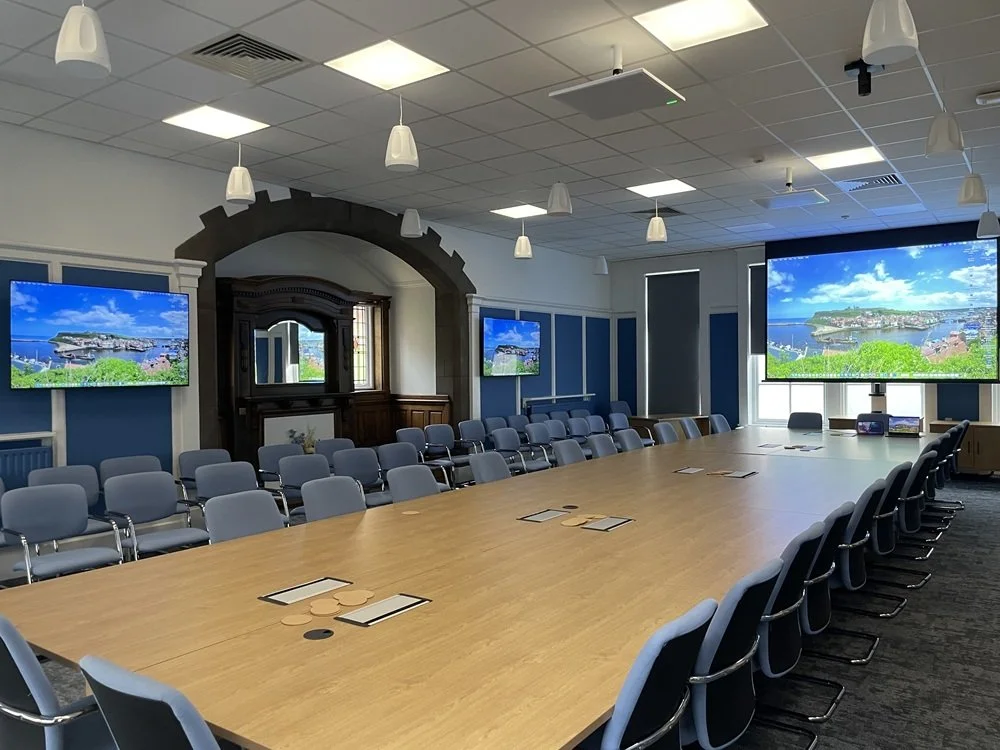
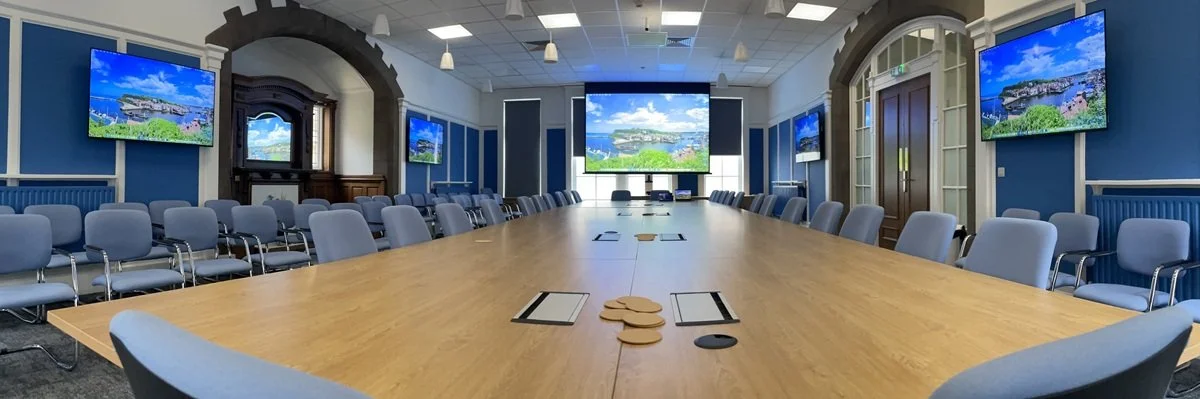
Leeds Teaching Hospitals NHS Trust required an integrated audio visual system for its Trust HQ Boardroom at St James’s University Hospital in Leeds. The large meeting space includes a boardroom table seating 26 people and a public gallery accommodating a further 27.
With over 50 people seated across the two areas, audio coverage was critical. Everyone needed to hear conversations clearly, regardless of their position in the room. The solution also needed to support presentations and Microsoft Teams meetings, with clear sightlines for presentations and simple one touch operation.
The Solution
We delivered an integrated system centred on intelligent voice reinforcement, known as voice lift. This is not a conventional PA system where every speaker reproduces the same audio at the same volume. Instead, speech is subtly reinforced only where it is needed.
The aim is to make conversations clearer and more natural, giving everyone the impression that each participant is speaking at a comfortable conversational level, regardless of where they are seated.
Two Shure MXA920 ceiling microphone arrays capture speech around the boardroom table, while 14 Shure MXN-6W pendant speakers distribute audio across the table and public gallery areas. A Q-SYS Core Nano processor manages audio mixing and distribution, with acoustic echo cancellation for remote meetings. Sennheiser SpeechLine lapel and handheld microphones provide additional options for presenters and people sat in the public gallery areas.
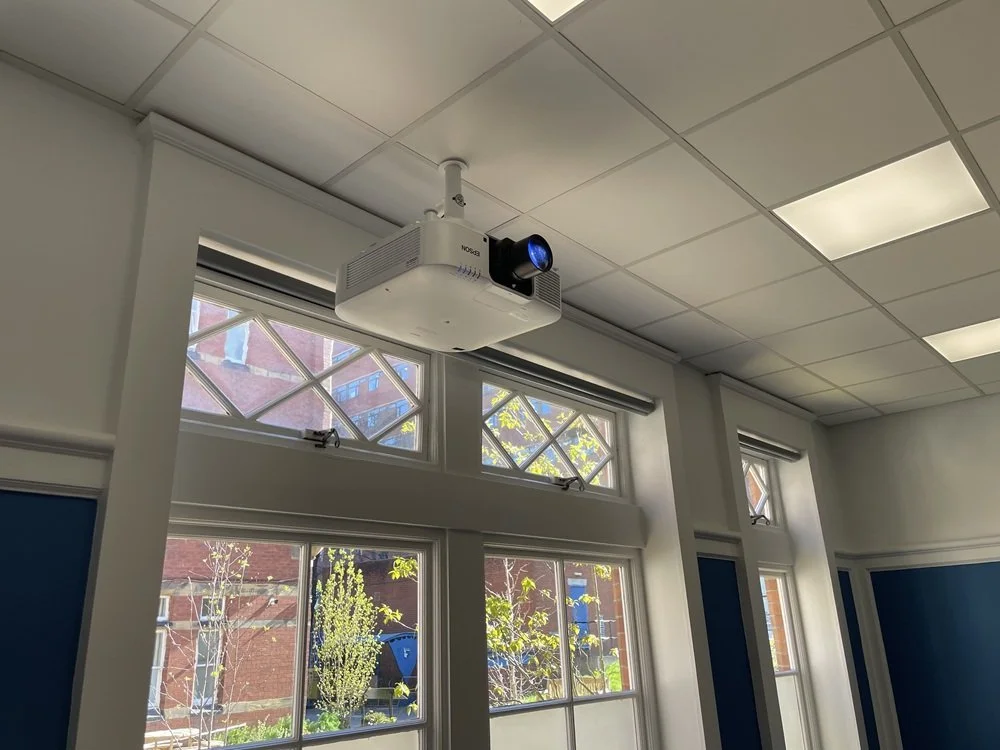
An Epson EB-PU2010 10,000 ANSI lumen laser projector, fitted with a long-throw lens, projects onto a recessed 3 metre wide 16:10 screen. Four 65-inch LG repeater displays show the same content around the room, helping participants follow presentations clearly from different seating positions.
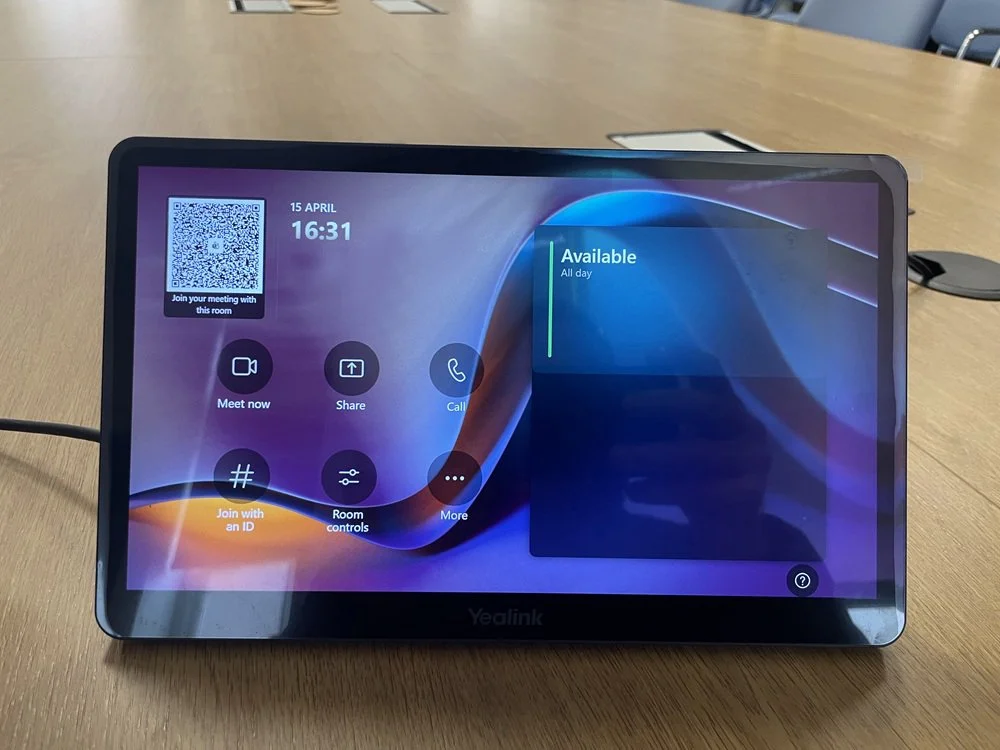
A Yealink Microsoft Teams Room system supports hybrid meetings, with two cameras providing presenter and wider room views. Wireless presentation dongles and bring-your-own-device connectivity give users options for sharing content from their laptops.
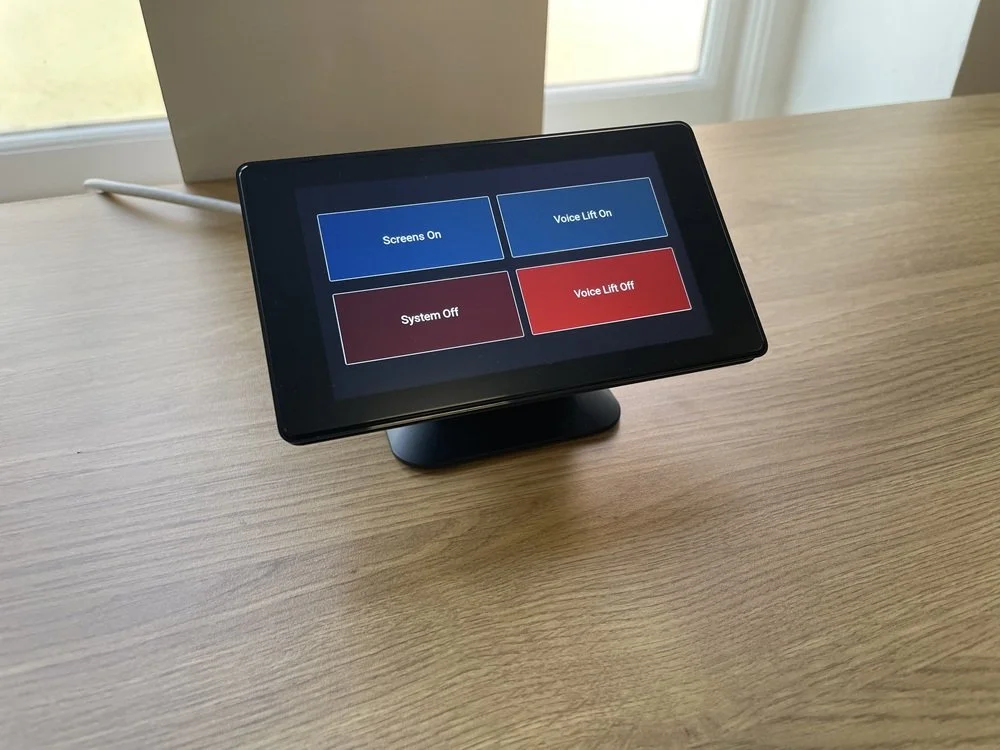
A Q-SYS TSC-50-G3 touch screen provides room control, with simple, intuitive, clear operation.
Key System Highlights
Voice lift designed for a 26-seat boardroom table and 27-seat public gallery
Two Shure MXA920 ceiling microphone arrays and 14 pendant speakers
Q-SYS Core Nano audio processing and touchscreen room control
Sennheiser SpeechLine lapel and handheld presenter microphones
10,000 ANSI lumen Epson laser projector and 3-metre recessed screen
Four 65-inch LG repeater displays with Extron DTP distribution
Yealink Microsoft Teams Room system with two camera views
Wireless content sharing and bring-your-own-device connectivity
The Result
The completed system brings presentation, hybrid meeting and voice lift facilities together in one large boardroom. Its defining feature is the emphasis on natural conversation: speech is reinforced where listeners need support, helping those around the table and in the public gallery follow the discussion. Large format projection, repeater displays and remote meeting facilities complement this approach, supporting participation both in the room and online.
Benefits Delivered
Clear, natural speech reinforcement across the boardroom and public gallery
Selective audio distribution rather than uniform amplification throughout the room
Shared presentation content visible from multiple seating positions
Video and audio facilities for Microsoft Teams participation
Simple selection between discussion and presentation modes
Flexible microphone and content sharing options for different meeting formats
Frequently Asked Questions
What is voice lift technology, and how does it differ from a traditional PA system?
Voice lift is an intelligent voice reinforcement technique designed for large meeting rooms and council chambers. Unlike a standard Public Address (PA) system - which amplifies a speaker's voice uniformly across all room speakers at a high volume - voice lift subtly reinforces speech only in the zones furthest from the speaker. This creates a natural acoustic environment where participants around a long table or in a public gallery can converse at normal speaking volumes without hearing unnatural electronic amplification.
How do ceiling microphone arrays support voice lift in large boardrooms?
Advanced ceiling microphone arrays (such as the Shure MXA920) use steerable beamforming technology to isolate and capture speech from specific seats around a boardroom table. Connected to a digital signal processor, the microphones track who is speaking in real time and route their voice exclusively to speakers located in distant areas of the room, avoiding local feedback loops.
How do you design audio coverage for boardrooms that include a public gallery or observer seating?
Managing audio in boardrooms with separate gallery seating requires multi-zone audio processing:
Multi-zone loudspeaker arrays: Installing pendant or directional ceiling speakers zoned separately over the boardroom table and gallery.
Dedicated presenter and Q&A mics: Using wireless handheld or lapel microphones for presenters and gallery audience members to ensure clear dialogue during public questions.
Acoustic Echo Cancellation (AEC): Processing every audio channel through a DSP core (such as a Q-SYS Core processor) so remote video participants hear clean speech without room reverb or gallery noise.
What are repeater displays, and why are they used alongside primary projectors?
Repeater displays are secondary commercial screens placed strategically around large or awkwardly shaped rooms. While a central laser projector and large screen serve as the primary visual focus, repeater displays (typically 65-inch to 75-inch screens) ensure that participants seated far away, facing sideways, or under gallery overhangs can view fine text, spreadsheets, and video feeds clearly without straining.
Why are high-lumen laser projectors preferred over standard lamps in large corporate boardrooms?
High-lumen laser projectors (such as 10,000 ANSI lumen units) offer distinct operational benefits for executive spaces:
Ambient light performance: Produces bright, crisp images that cut through ambient office and ceiling lighting without needing the blinds drawn.
Instant power-on/off: Eliminates lamp warm-up and cool-down delays during executive meetings.
Low maintenance: Operates for up to 20,000 hours without requiring costly bulb replacements or filter maintenance.
How does a Q-SYS audio processor manage hybrid video calls and local voice amplification?
An audio processor (such as the Q-SYS Core series) acts as the central brain of a boardroom setup. It simultaneously manages multiple audio tasks:
Route microphone feeds to local voice lift speaker zones.
Applies acoustic echo cancellation and noise reduction to all microphone channels.
Mixes and feeds clean, unified audio into hybrid conferencing software (like Microsoft Teams or Zoom).
Communicates with touchscreen interfaces to give users single-touch control over volume presets.
What video distribution technology is used to feed multiple displays without signal degradation?
To route high-definition 4K video feeds across large distances to multiple displays and projectors simultaneously, integrators use professional AV distribution frameworks like Extron DTP or HDBaseT. These technologies send uncompressed video, audio, and control signals over standard Cat6/Cat6A network cables across distances up to 100 metres without latency or visual loss.
How can dual-camera setups improve hybrid Microsoft Teams meetings in wide boardrooms?
In large boardrooms, a single wide-angle camera often makes participants at the end of the table appear tiny and unreadable. Using a dual-camera setup connected to a native Teams Room system allows one camera to focus on the active presenter or podium while the second camera captures a wide-angle framing of the boardroom table, providing remote callers with a dynamic and inclusive view.
Why is simple touch-panel control essential for multi-function boardrooms?
Large-scale boardrooms feature complex underlying AV networks. Custom-programmed touch control panels (such as Q-SYS or Extron touchscreens) simplify room operation into clear presets:
Discussion Mode: Activates table microphones and voice lift for internal board reviews.
Presentation Mode: Switches display inputs to the main podium or wireless laptop connection and optimizes audio for media playback.
Hybrid Video Call Mode: Launches Microsoft Teams meetings with single-tap camera framing and master volume control.
How do wireless dongles and BYOD connectivity options enhance boardroom flexibility?
Providing flexible Bring Your Own Device (BYOD) options - such as plug-and-play wireless presentation dongles alongside dedicated HDMI connection points - allows visiting executives, presenters, and guest speakers to share content instantly from personal laptops without requiring complex network permissions, guest Wi-Fi configurations, or software installations.
What specific compliance and technical standards are required for AV installations within NHS healthcare environments?
Audio-visual installations within NHS and healthcare facilities must adhere to strict operational, hygiene, and data security standards:
Infection control and cleanability: Equipment installed in clinical or public-facing areas must feature smooth, non-porous surfaces that withstand hospital-grade chemical disinfectants without hardware degradation.
Information governance (IG) and data privacy: Video conferencing endpoints must enforce end-to-end encryption and strict network isolation (such as dedicated VLANs) to prevent unauthorized interception of confidential patient or trust data during remote consultations and multidisciplinary team (MDT) meetings.
Acoustic privacy and sound masking: High-level executive, clinical, and governance meeting rooms require acoustic containment measures (such as sound-damping wall panels and directional speakers) to prevent patient data or confidential board discussions from leaking into adjacent corridors.
How does voice lift technology support accessibility and inclusion in large NHS public board meetings?
Public board meetings and healthcare trust governance assemblies frequently involve diverse participants, including members of the public, clinical directors, patient representatives, and individuals with hearing impairments:
Natural speech reinforcement: Voice lift subtly amplifies voices across large rooms so everyone in the public gallery or at the end of the table can hear clearly without the jarring effect of a loud, traditional PA system.
Assistive listening integration: Modern voice lift systems route audio directly into hearing loop systems (induction loops) or wireless infrared/FM assistive listening receivers, ensuring full accessibility compliance for hearing-aid users.
Hybrid public access: Integrated audio processors route clean, echo-free voice signals directly to remote webcasting or video conferencing streams, enabling transparent public observation without ambient room noise.